
Your go-to resource for weed knowledge.
Purpletop Rhodes grass
Chloris inflata
Poaceae
Medicinal


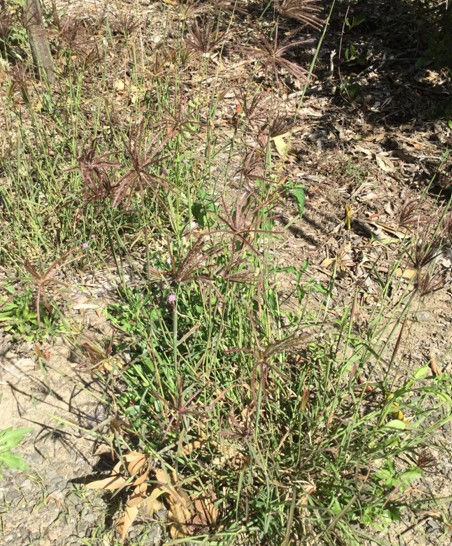
Purpletop Rhodes grass is an annual or periennial with a tufted growth habit, ranging in height from 20 to 100 cm tall. Leaves range from 4 to 40 cm long and 2 to 5 mm wide, while the purple coloured seed heads form at the end of stems. This grass can be found growing in a range of soil types and is known to be tolerant of saline and dry soils. In the north of Australia, it can be found growing in seasonally wet areas such as claypans, river flood flats, creek beds and banks (Cape York NRM). Sugar Research Australia information report that it is widespread and common in areas of poor soil and its presence can indicate soil that is saline or sodic. It also grows on highly compacted soils. It is reported to be an aggressive invader of degraded land and will outcompete other species. It can be commonly found in gardens, parks, orchards, cultivation, degraded sites and pastures. Some data indicates this plant might have allelopathic properties - reduced growth of other plants.
Purpletop Rhodes grass is a host of a number of rice insect pests and diseases, some of which include: White-backed planthoppers, Rice bug (Leptocorisa oratorius), Rice earcutting caterpillar (Mythimna separata), Tiger moth (Creatonotus gangis), Cereal thrips (Haplothrips ganglbaurei), Rice whitefly (Aleurocybotus indicus), Sheath blight (Rhizoctonia solani), Rice leaffolder (Cnaphalocrocis medinalis), Grass seed-feeding thrips (Chirothrips mexicanus).